Avatar World Family Roleplay: Story Ideas and Complete Setup Guide!
Avatar World family roleplay is the most sustained and creatively rich scenario type in the game. Unlike single-location stories that resolve in one session, a family roleplay can run indefinitely. Every day is a new session, every session is a new chapter, and the home you have built becomes the backdrop for an ongoing story that grows more detailed the longer you play.
This guide covers how to set up a complete Avatar World family roleplay from the character creation stage through to long-term story development, including scene-by-scene guides for everyday family moments and larger story arcs that give your family’s life genuine narrative shape.
Building Your Family: Using Avatar Slots Strategically
The foundation of Avatar World family roleplay is your avatar configuration. The game gives you three free avatar slots, and how you use them determines what kinds of family stories you can tell.
Two-parent, one-child family: One parent avatar, one child avatar, and your third slot as either another parent figure or a sibling. This is the most versatile setup because the contrast between adult and child characters creates a natural dynamic between sessions.
Single parent and two children: Your most experienced avatar as the parent, two child avatars with contrasting personalities. The sibling dynamic adds conflict and warmth in equal measure to every scene.
Extended family: Use your three slots for three generations. Grandparent, parent, and child create a different set of relationships than the nuclear family setup, and open story possibilities that two-generation families cannot access.
Each avatar needs a distinct visual identity that makes their role immediately readable. The parent character should look composed and adult. A structured outfit, a practical hairstyle, slightly more formal than the child characters.
The child character should look younger and more casual. A smaller, more playful outfit. A simpler hairstyle. An expression that reads as curious or energetic rather than composed.
For the full avatar creation process for each family member, see our Avatar World avatar creation guide.
Setting Up the Family Home
The home is the central location for all family roleplay. How it is arranged determines what kinds of scenes are possible within it.
Kitchen: The most active room in any family home story. Morning breakfast, evening dinner preparation, weekend cooking. The kitchen is where the family gathers before and after the outside world pulls them in different directions.
Living room: The family gathering space for evenings, weekends, and the quiet moments between activities. A sofa large enough for multiple avatars, a television unit, a rug, and a coffee table with items on it.
Bedroom(s): Each family member should ideally have a distinct sleeping space, even if it is a corner of a shared room for a child character. Morning routines start here.
Child’s room: A room that reads as belonging to a younger character. Smaller furniture, more colorful decoration, toys, or books on shelves. This room is the scene for bedtime stories, homework sessions, and the moments when a child character needs privacy.
For specific room setup guides covering home offices, kids’ rooms, and other specialty spaces, see our Avatar World room ideas guide.
The Family Day: Scene-by-Scene Guide
A single family roleplay session works best when it follows the natural rhythm of a real day. This gives the session a structure without forcing a dramatic story arc on every session.
The Morning
Kitchen: The first scene of every family day. The parent avatar is already in the kitchen when the session starts. The child avatar wakes up and comes through. Breakfast. The pet (if you have one) needs feeding. Someone is running slightly late. The morning is the most reliably interesting family scene because it has natural low-level tension built in without needing any dramatic event to justify it.
Bedroom preparation: After breakfast, each character prepares for their day. The parent avatar gets ready for work. The child avatar gets ready for school. Use the clothing interaction in the wardrobe between the kitchen scene and the departure.
Departure: The family leaves the home. The parent drops the child off at school before going to work. This moment, brief as it is, is one of the most emotionally resonant in family roleplay because it signals the transition from the safe domestic space to the outside world.
The School and Work Day
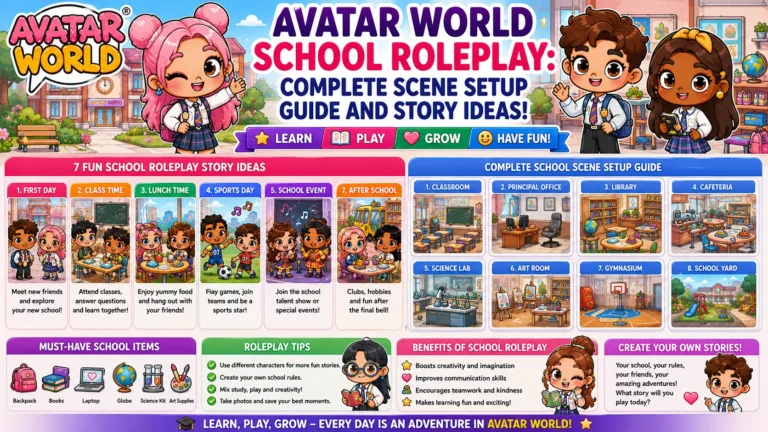
This is where family roleplay connects to other scenario types. The child’s school day becomes its own session or a connected session using the school roleplay structure. For the complete school day setup, see our Avatar World school roleplay guide.
Meanwhile, the parent character’s workday can be roleplayed in parallel using the hospital, mall, or any professional location as the work environment. The two storylines running in the same session create a richer sense of a family whose members have full lives independent of each other.
The Evening
Return home: Both characters arrive back at the home in the early evening. The transition from the outside world back to the domestic space is its own scene. What does each character bring home from their day?
Dinner: The kitchen again, this time for the evening meal. Cooking, setting the table, and the conversation that happens while food is being prepared. The food delivery app adds food props to the dining scene.
Evening activity: A family game. Homework at the kitchen table while a parent works nearby. Television in the living room. A conversation that starts casually and becomes something more important.
Bedtime: The child avatar goes to bed. The parent character has a moment alone in the living room after the day is done. This quiet ending scene is one of the most underrated moments in family roleplay.
Avatar World Family Roleplay Story Arcs
Arc 1: The New Home
The family has just moved to a new city. The first session is the arrival at an empty or minimally furnished apartment. Each subsequent session adds furniture, establishes routines, and builds the family’s place in their new city.
The story is about the process of making somewhere feel like home, which mirrors exactly what the home builder mechanic does in Avatar World. The game and the story are doing the same thing simultaneously.
Arc 2: The New Baby
A new family member arrives. This can be role-play-represented by introducing a new NPC who becomes a permanent part of the home scenes, or by creating a fourth avatar (if you have Pazu Plus) as the new child character.
The story covers the preparation before the arrival, the adjustment after, the way the existing family members respond differently to the change, and the gradual integration of the new member into the family’s routines.
Arc 3: The Family in Crisis
Something disrupts the normal rhythm of family life. A parent loses their job. A child is struggling at school. A relationship in the family is under strain.
The arc is not about the crisis itself but about how the family responds to it. Who holds things together? Who falls apart. What they discover about each other when the routine breaks down.
This arc works best as a multi-session story because the resolution of a family crisis is rarely sudden and rarely clean. The slow rebuilding of normal life after a difficult period is where the most interesting character work happens.
Arc 4: The Family Holiday
The entire family goes on vacation together. The beach and island world is the natural destination. The story covers packing at home, the travel, arrival at the beach, different activities across the vacation days, and the return home.
What makes the holiday arc distinctive from a regular beach roleplay is the family dynamic throughout. How a parent and child experience the same location is different from how two friends experience it. The protective, guiding quality of the parent character in an unfamiliar environment adds a layer that solo or friend roleplay does not have.
Arc 5: The Ordinary Week
The least dramatic arc and often the most satisfying. Seven sessions, one for each day of the week. Monday through Friday follow the school and work structure. Saturday is a family outing. Sunday is a home day.
No crisis, no drama, no major event. Just the texture of an ordinary family’s week played out across seven sessions. The richness comes from the accumulation of small moments rather than any single story event.
This arc is particularly effective for players who want an ongoing roleplay story they can return to without needing to remember where a complex narrative left off.
Connecting Family Roleplay to Other Scenario Types
The family story becomes most interesting when it connects to other roleplay types across the game.
School roleplay as the child’s day: Use the school location for the child character’s school day scenes as a connected session to the family morning. What happens at school during the day matters to the family evening scene that follows.
Doctor roleplay as a family moment: When a family member needs medical care, the hospital roleplay becomes part of the family story rather than a separate scenario. The parent taking a child to the hospital is a different hospital scene than the standalone doctor roleplay, emotionally richer because of the relationship between the characters.
Shopping trip as family time: The mall becomes a different location when visited as a family compared to a solo or friend shopping trip. The child character wants to go to the arcade. The parent character needs to do practical shopping. The negotiation between those two agendas is the story.
Tips for Better Family Roleplay
Keep consistent character identities across sessions. The parent character should always dress and behave consistently with the character identity you established for them. The child character should do the same. Consistency across sessions is what makes the family feel like a real ongoing story rather than a series of disconnected scenes.
Let small moments be enough. Not every family roleplay session needs a dramatic arc. A morning routine that goes smoothly, an evening that is just quiet and domestic, a weekend where nothing in particular happens. These sessions build the texture of a family life in a way that constant dramatic events cannot.
Use the pet as a family connective tissue. If your home has a pet, the pet’s care routine connects every family member across every scene. Whoever feeds the pet in the morning, whoever plays with them in the evening. The pet is a constant that every family member has a relationship with.
Track the story across sessions mentally. The best family roleplay players remember what happened in the previous session and let it affect the current one. If the child character had a difficult day at school yesterday, today they are slightly quieter. If the family had a conflict last session, the resolution of it shapes how this session starts.
For guidance on earning more coins to expand your home and family wardrobe through regular gameplay, see our Avatar World tips and tricks guide.
You can also find Avatar World at Avatar World on Google Play.
Final Thoughts
Avatar World family roleplay is the most open-ended creative scenario in the game because a family’s story has no natural endpoint. Every session is the next chapter. Every location the family visits together becomes part of their shared history. Every small daily moment builds the texture of a life that feels genuinely lived rather than performed.
Set up your characters with distinct identities, build a home that supports the scenes you want to play, follow the natural rhythm of a day for structure, and let the story develop at its own pace.
For the full collection of Avatar World roleplay scenario ideas across every theme, see our Avatar World roleplay ideas guide.