Did Melania Trump Really Challenge Dolly Parton on Johnny Carson’s Show? The Truth Behind the Viral Story
The laughter had been effortless until Melania Trump turned toward Dolly Parton and asked the one question no one in the studio had expected.
It began as a glittering television conversation filled with playful jokes, elegant compliments, and Johnny Carson’s familiar late-night charm. The audience had come to be entertained. They expected music, laughter, and perhaps a few harmless stories about fame. Instead, they witnessed an exchange that changed the atmosphere so completely that hundreds of people seemed to stop breathing at once.
At first, Dolly was smiling.
Then Melania made her remark.
The smile slowly disappeared.
Johnny Carson glanced toward his bandleader and then back at the two women sitting beside his desk. For a few uncomfortable seconds, no one knew whether the conversation would recover. Dolly lowered her eyes, folded her hands in her lap, and appeared to consider whether the comment deserved a response.
Then she leaned toward the microphone.
What she said next did not sound angry. She did not raise her voice, insult Melania, or ask the audience to take her side. She simply delivered one calm sentence that transformed an awkward joke into a lesson about dignity, identity, and the danger of judging a woman by the way she chooses to appear.
By the time Dolly finished speaking, Melania was silent.
Johnny Carson was staring at her.
And the audience was no longer laughing.
:max_bytes(150000):strip_icc():focal(999x0:1001x2)/dolly-parton-portraits-PEOPLE-6-f306780e9efd48b989bd5b7b938dba4d.jpg "Did Melania Trump Really Challenge Dolly Parton on Johnny Carson’s Show? The Truth Behind the Viral Story 1")
A Conversation That Began With Laughter
The fictional evening had started exactly as audiences expected a classic Tonight Show interview to begin. Johnny Carson stepped through the curtain, delivered his opening monologue, and settled behind the desk that had become one of the most recognizable pieces of furniture in American television.
Dolly Parton entered first.
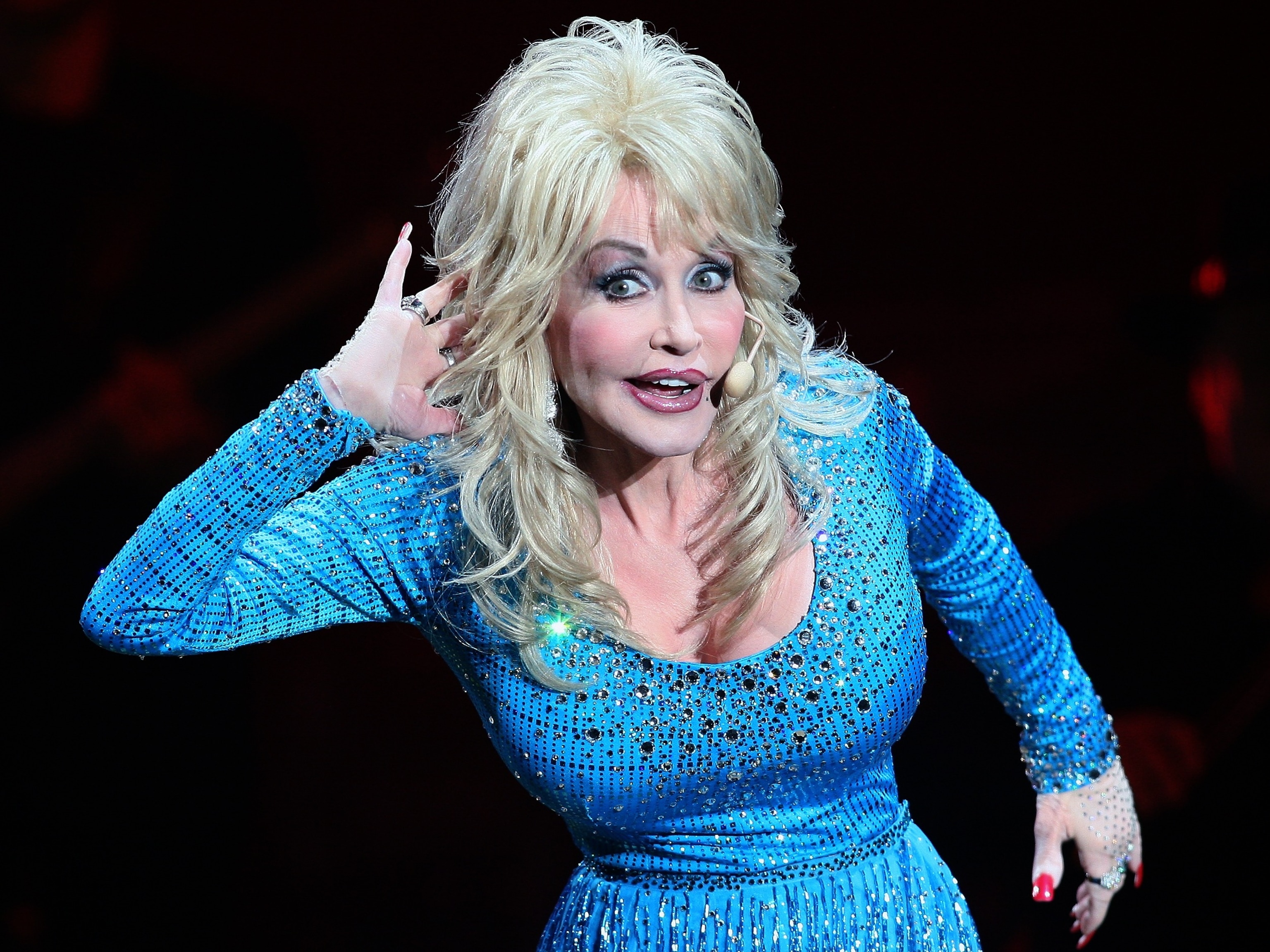
The crowd rose almost immediately. She greeted Carson with a warm embrace, waved to the band, and sat down with the comfortable confidence of someone who had learned how to make an enormous studio feel like a neighbor’s living room. Her dress shimmered beneath the lights, and her blond hair rose high above her head in the unmistakable style that had become part of her public identity.
Melania entered moments later with a very different kind of presence. Where Dolly sparkled, Melania appeared composed and reserved. She walked carefully, smiled politely, and chose each word with precision. The contrast between them was impossible to miss, but it initially gave the conversation an entertaining rhythm.
Carson joked about how differently the two women approached fashion.
Dolly laughed first.
“Well, Johnny,” she said, “it takes a lot of money to look this inexpensive.”
The audience erupted. Carson lowered his head and laughed into his hand while Melania smiled beside Dolly. It was the kind of self-deprecating line Dolly had mastered—the ability to make a joke about herself while quietly reminding everyone that she controlled the joke.
For several minutes, the conversation remained light. They discussed beauty, public attention, and the expectations placed on famous women. Carson asked whether appearance could become a kind of armor.
Melania answered that elegance was often about restraint. She spoke about simplicity, discipline, and the power of never revealing too much. Dolly nodded respectfully and replied that every woman should be free to decide what makes her feel most like herself.
Then the tone shifted.

The Remark That Changed the Room
Melania looked at Dolly’s towering hair, jeweled dress, long fingernails, and sparkling heels. Her expression remained calm, but her next observation carried an unmistakably sharp edge.
“Sometimes,” she said in this fictional exchange, “when a woman works this hard to attract attention, people may wonder what she is trying to hide underneath it.”
A few audience members laughed automatically.
Then the laughter faded.
Carson’s smile tightened. He turned toward Dolly, perhaps expecting another playful answer. Dolly usually met uncomfortable questions with humor. She had spent years transforming condescension into punch lines and assumptions into opportunities.
This time, however, she did not laugh.
She looked down at her hands. The studio became so quiet that the soft movement of a camera could be heard across the stage. Melania remained composed, but her eyes shifted toward Carson as though she had suddenly realized that the remark had landed more heavily than intended.
Carson attempted to loosen the tension.
“Well,” he said, “I’ve been wearing the same kind of suit for twenty years, so perhaps I’m hiding more than anyone.”
The audience offered a nervous laugh, but Dolly remained still.
For years, people had looked at her and seen only the surface. They saw the blond wigs, bright lipstick, rhinestones, and exaggerated femininity. They did not always see the child who had grown up in poverty in the mountains of Tennessee. They did not see the songwriter working alone with a melody before sunrise. They did not see the businesswoman reading contracts, protecting her work, and building opportunities for people from communities like the one she had come from.
Most of all, they did not understand that the image was never a disguise forced upon her.
It was a choice.
It was art.
It was armor.
And it belonged to her.

Dolly Parton Stopped Smiling
When Dolly finally lifted her head, there was no fury in her expression. She turned toward Melania and spoke slowly enough that every person in the room could hear each word.
“Darlin’, some women dress quietly because they want the world to listen,” Dolly said. “I dressed loudly because the world kept pretending it couldn’t hear me.”
The studio fell silent.
Carson stopped moving. Melania’s carefully maintained smile disappeared for a moment, replaced by an expression that was more thoughtful than offended. In the audience, people who had expected an insult were instead confronted with something far more powerful.
Dolly had not attacked Melania’s clothes, character, or life. She had not suggested that one version of femininity was superior to another. She had simply explained why her appearance had never been an apology.
For Dolly, glamour was not the opposite of intelligence. Humor was not proof of weakness. Kindness did not mean that she lacked boundaries, and a smile did not mean she could not recognize disrespect.
She had spent much of her life being underestimated by people who mistook brightness for shallowness. Some saw a country girl dressed in rhinestones and assumed she could be controlled. Others believed that because she laughed at herself, she would tolerate being diminished by others.
They were wrong.
Dolly’s response reminded the room that a woman does not have to abandon softness to demonstrate strength. She does not have to become cruel to prove that she cannot be dismissed. Sometimes the strongest answer is the one delivered without anger because it leaves the other person nowhere to hide.
Melania’s Unexpected Reaction
For several seconds, Melania said nothing. Carson looked between the two women, waiting to see whether the conversation would become more confrontational.
It did not.
Melania slowly nodded.
“That is a strong answer,” she said.
Dolly’s expression softened, but she did not immediately return to her usual smile.
“It’s an honest one,” she replied. “People have been deciding what women mean by the way they look for longer than either one of us has been alive.”
The tension in the room began to change. It did not disappear; it deepened into something more reflective. What had started as a pointed remark was becoming a conversation about the expectations placed upon women in public life.
Melania explained that she had also experienced being judged before speaking. People often decided whether she was intelligent, distant, powerful, or weak based on a photograph, a dress, or a facial expression. Dolly listened without interrupting.
“That’s the trap,” Dolly said. “They look at you and think they know you. Then we sometimes turn around and do the same thing to another woman.”
This time, the silence felt different.
It was not the uncomfortable stillness that follows an insult. It was the kind of silence that arrives when people recognize themselves inside a difficult truth.
Dolly could have used the moment to embarrass Melania. The audience was already leaning in her direction. One sharper joke might have produced enormous applause.
But humiliation was not the victory she wanted.
Understanding was.
The Woman Behind the Rhinestones
Dolly had learned long ago that appearances could create both power and misunderstanding. Her image opened doors because it made her unforgettable, but it also encouraged people to underestimate her intelligence.
She understood exactly what critics saw when she entered a room. She knew they noticed the hair before the songwriting, the figure before the business instincts, and the laughter before the discipline. Instead of begging them to look deeper, she continued doing the work until ignoring her substance became impossible.
The poor girl from Tennessee became a songwriter whose music crossed genres and generations. She turned personal heartbreak into songs that millions recognized as their own. She built a business empire without pretending to be someone else. She gave books to children, supported communities, and used her success to create opportunities beyond herself.
None of it required her to remove the rhinestones.
That may have been the most important part of her message. Dolly did not succeed after abandoning her public image. She succeeded while embracing it. She demonstrated that a woman could be playful and powerful, glamorous and generous, ambitious and compassionate.
People frequently demanded that women choose. Be beautiful, but do not appear vain. Be intelligent, but do not make others uncomfortable. Be confident, but never too confident. Be successful, but remain grateful for every seat offered at someone else’s table.
Dolly built her own table.
Then she invited others to sit beside her.
Carson Asked One Final Question
Sensing that the exchange had reached something deeper than late-night entertainment, Carson leaned forward.
“Do you think people ever truly stop judging one another by appearances?” he asked.
Dolly thought for a moment.
“No,” she answered. “I think we all notice the wrapping first. That’s human. The trouble starts when we decide there can’t be anything valuable inside the package.”
The audience applauded, but Dolly raised one hand gently, signaling that she had not finished.
“And sometimes,” she continued, “the wrapping is valuable too. A woman shouldn’t have to dress plainly before people believe she has a mind. And she shouldn’t have to dress beautifully before people believe she matters.”
Melania turned fully toward Dolly.
“I may have judged the wrapping,” she admitted in the fictional scene.
Dolly’s smile finally returned.
“Well, honey, it is a lot of wrapping.”
The studio erupted in laughter—not the nervous laughter that had followed Melania’s earlier remark, but the warm release of an audience realizing that the moment had not ended in bitterness.
Dolly reached across and touched Melania’s hand.
“I’ve been underestimated by better people than you,” she joked.
Carson leaned back in his chair.
“And worse people than her, I assume?”
“Oh, Johnny,” Dolly replied, “you’ve interviewed some of them.”
The audience roared again.
The Comeback No One Expected
What made Dolly’s fictional response so powerful was not that she defeated another woman. It was that she refused to turn the conversation into a contest.
She could have attacked. Instead, she explained.
She could have embarrassed Melania. Instead, she held up a mirror.
She could have used the audience’s support as a weapon. Instead, she transformed an awkward moment into a lesson about the assumptions everyone carries.
The exchange imagined here resonates because so many people know what it feels like to be reduced to a surface. They have been judged by their clothes, accents, jobs, age, education, bodies, neighborhoods, or backgrounds. They have walked into rooms where people made decisions about them before hearing a single word.
Dolly’s response speaks to all of them.
“I dressed loudly because the world kept pretending it couldn’t hear me.”
The sentence is fictional, but the struggle behind it is real. Dolly Parton’s career has repeatedly demonstrated that a person can transform what others mock into a source of power. Her appearance became part of her art. Her humor became a way of disarming prejudice. Her generosity became evidence that success did not have to make a person forget where she came from.
Melania’s fictional remark created the tension, but Dolly’s answer revealed the larger truth: dignity does not always arrive with a raised voice.
Sometimes dignity smiles.
Sometimes it wears rhinestones.
Sometimes it waits patiently until a room becomes quiet enough to listen.
The Lesson That Outlived the Applause
At the end of the imagined interview, Carson thanked both women. Melania and Dolly stood, exchanged a brief embrace, and waved to the audience. The band began playing, the cameras pulled back, and the bright red light above the main camera went dark.
But the emotional weight of the exchange lingered.
People would not have remembered it because Dolly delivered the cruelest insult. They would have remembered it because she resisted cruelty when cruelty would have been easy. She defended herself without losing the warmth that made people love her.
That distinction matters.
Strength is often confused with domination. A powerful comeback is assumed to require leaving another person humiliated. Yet Dolly demonstrated another possibility: the strongest person in a difficult exchange may be the one who can protect her dignity without destroying someone else’s.
Her fictional words changed the atmosphere because they carried the weight of a lifetime. Dolly knew what it meant to rise from poverty, confront dismissal, and remain recognizable to herself through every stage of success. She had not built an empire by being unaware of how people perceived her. She built it by understanding their assumptions and refusing to live inside them.
The hair was real.
The glitter was real.
The smile was real.
But so were the intelligence, ambition, discipline, generosity, and steel beneath them.
Melania may have entered the conversation believing that appearance concealed identity. Dolly reminded everyone that appearance can also be an expression of identity—a declaration that the world does not get to decide how a woman must look before taking her seriously.
And when Dolly finally smiled again, the room understood something it had not understood before.
She had never needed anyone’s permission to shine.