Avatar World School Roleplay: Complete Scene Setup Guide and Story Ideas!
Avatar World school roleplay is consistently one of the most popular scenarios in the game, and it is easy to see why. The school location has everything: a classroom with desks and a board, a cafeteria with food interactions, a playground with equipment, and a principal’s office for the moments when things go sideways.
This guide covers exactly how to set up the best Avatar World school roleplay sessions, which character roles work in each part of the building, and story arcs that turn a generic school day into something with real narrative momentum.
Pazu Games built the school as one of the core free locations in Avatar World, accessible from the moment you install.
The School Location: What You Are Working With
Before setting up a scene, know what each area of the school offers.
The classroom is the central space. Student desks, a teacher’s board at the front, and interactive school supplies on the desks. Every object in the classroom is tappable. This is where most of the school-day roleplay happens.
The cafeteria is a fully separate room with food interactions, trays, and seating. This is the social epicenter of any school day story. The cafeteria scene is where friendships start, where conflicts happen, and where the social dynamics of the school play out.
The playground is the outdoor area attached to the school. Climbing equipment, benches, and open space. Recess and after-school scenes happen here. It is a lighter, freer environment than the structured classroom.
The principal’s office is a smaller room with a desk and interactive items. Used for discipline scenes, serious conversations, and moments when the stakes in the story go up.
Step 1: Dress Your Character for School
The school location reads best when your avatar is dressed for it. The goal is smart-casual: neat enough to look like a student or teacher, relaxed enough that it does not look like a wedding.
Student: A solid-color polo or blouse, clean bottoms (trousers, a skirt, or neat jeans), simple flat shoes or sneakers, and a backpack if one is available in your wardrobe. Add glasses for a studious character type.
Teacher: A more structured outfit than the student. A button-up shirt or blouse with tailored trousers or a professional skirt. Flat shoes. Minimal accessories. The teacher should look composed and prepared.
Principal: The most formal outfit in your wardrobe, short of formal event wear. A blazer over a shirt. Structured shoes. The principal character reads as an authority immediately when the outfit signals it.
New student: Slightly less put-together than the regular students. Something that reads as coming from a different school uniform or a different style background. The visual distinction signals outsider status immediately.
For hairstyle guidance that fits each school character type, see our Avatar World hairstyle guide.
Step 2: Set Up the Classroom Before the Session Starts
The difference between a good school roleplay and a great one is almost always the setup before the first scene.
Open the phone contacts list while inside the school. Summon five or six NPC characters to the classroom. Position your teacher avatar (if you are using two avatar slots) at the front near the board. Position your student character at a desk near the middle or back.
When the scene begins, the room is already populated. The teacher is at the front. The students are in their seats. The school day has already started when your story begins, which is a much stronger opening than arriving at an empty building.
Avatar World School Roleplay Story Arcs
Arc 1: The New Kid
This is the most emotionally rich school story in Avatar World because the outsider perspective gives every scene a built-in tension.
Your character is new. They do not know anyone, they do not know the social rules, and every interaction carries the uncertainty of not knowing how it will land.
Morning: Arrives at the classroom. Finds an empty desk. Tries not to make eye contact with anyone while also hoping someone notices them.
Lesson: The teacher introduces the new student to the class. NPCs react. Your character sits back down with everyone looking at them.
Cafeteria: The pivotal scene. Does anyone invite them to sit? Or do they sit alone and wait to see if someone comes over? This single scene has more story potential than the rest of the school day combined.
Playground: Someone from the cafeteria scene finds them. The first real conversation. The beginning of something.
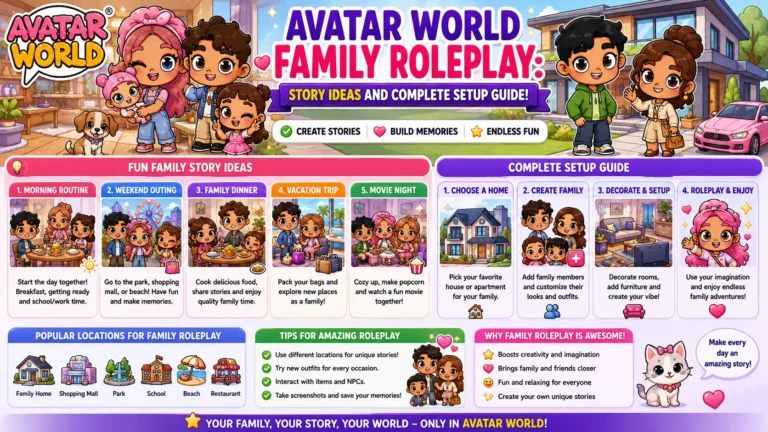
End of day: Your character goes home and tells their family about it. This connects naturally to the family roleplay. See our Avatar World family roleplay guide for how to run the home scene after a school day.
Arc 2: The Teacher’s First Year
Your character is a newly qualified teacher on their first day of school as the adult in the room. They know their subject. They do not know how to manage a classroom full of kids who have each other figured out in ways they do not.
Morning: Arrives early. Sets up the classroom before students arrive. Reviews notes.
First lesson: The NPCs are students now. Your character is on the board. Something does not go to plan in the first five minutes.
Cafeteria: The teacher eats alone in the teacher’s area. Watches the students interact. Realizes how different the room looks from this side.
Afternoon lesson: Goes better. One student responds in a way that makes the whole session feel worthwhile.
End of day: The classroom is empty. Your character sits at the desk and thinks about what tomorrow will look like.
Arc 3: The School Project Crisis
Two students (two avatar slots) are working on a project together. The deadline is tomorrow. The project is not done. They have to figure out how to finish it, how to deal with the fact that one of them has not done their part, and whether the friendship survives the stress.
Classroom: The teacher announces the deadline. Your two characters look at each other.
Cafeteria: The confrontation. One character tells the other they have not done their share. The conversation that follows determines whether the friendship holds.
Playground: A tense debrief. They decide to finish it together after school.
Home: Switch to your home location for the evening study session. Use the home office setup for the final push before the deadline.
Arc 4: The School Talent Show
The school is putting on a talent show. Your character has decided to enter. The story is about preparation, nerves, and the performance itself.
This arc benefits from using the mall’s talent show or photo studio feature for the performance scene itself, then returning to the school for the aftermath. The contrast between the school preparation scenes and the performance venue creates a natural story shape.
Tips for Better School Roleplay in the Avatar World
Use the board interaction for lesson scenes. The teacher’s board at the front of the classroom is interactive. Tapping it while your teacher character is standing at the front creates an authentic lesson animation. It is a small detail, but it makes the classroom scene feel like an actual lesson rather than just characters standing in a room.
Time the cafeteria scene carefully. The cafeteria is the most socially charged location in the school. Do not rush through it. Let the scene breathe. Place your character in a seat and let the populated NPCs around them create the atmosphere before any story action happens.
Use daily quests as school events. When your quest list includes school-related tasks, complete them in character. A quest to interact with a school object becomes your character doing classwork. A quest to visit a specific location becomes your character running an errand for the teacher. Our Avatar World quests guide covers how to integrate quests naturally into roleplay sessions.
Use the principal’s office deliberately. The principal’s office should be a destination that means something in the story, not just another room to explore. Reserve it for moments of consequence: a conversation after something goes wrong, a commendation for something that went right, or a meeting that changes the direction of the story.
Accessing Premium School Items
Some of the best school-themed outfits and back-to-school seasonal items require coins or Pazu Plus in the standard version. All of these are available from installation with avatar world mods from this site, giving you the complete school wardrobe without any coin restrictions.
Final Thoughts
Avatar World school roleplay works because the school location is designed with enough distinct spaces to tell a full story across a single session. Classroom, cafeteria, playground, and principal’s office each serve a different narrative function.
Set up the scene before you start, dress every character for their role, and use the different areas of the building to create natural scene transitions rather than staying in one room for the entire session. The school day has a shape. Let your story follow it.